Mike-Radio FM Microphone Radio (1961)
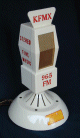
This charming novelty radio takes the form of an old broadcast microphone. Labeled with station
call letters KFMX, it stands about 15 inches high and receives only one FM channel at 96.5 Mhz.
Single-channel "mike" radios were promotional items (see the note below). KFMX 96.5 was
located in San Diego and began broadcasting around 1961. That's about the same time
that stereo FM broadcasting began in the US. The case boasts of STEREO as well as
FINE MUSIC. This is a mono radio, but the KFMX broadcasts must have been in stereo.
The radio is in fine condition except for a couple of little scrapes on the label.
It was produced by Universal Publicizers in Chicago, who presumably
contracted with a radio manufacturer for the chassis.
The case is made of sturdy white plastic with painted red lettering. The speaker is in the circular
base and the rest of the radio is in the rotating "microphone" body above.
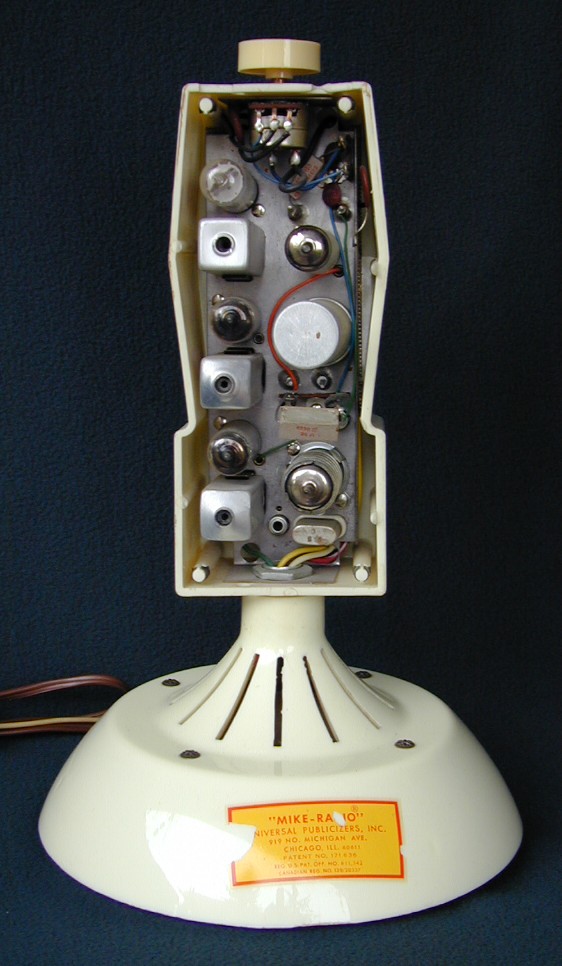
Don't bother looking for a tuning knob. It doesn't have one! In place of a conventional tuner, it
uses a crystal and coil to receive a station at 96.5 Mhz. The only control
is a power/volume knob on the top.
The Mike-Radio uses five tubes, of types 12AV6, 12BA6, 12BA6, 19EA8, and 50C5. It is a conventional
All American Five AC/DC design, with a multi-function 19EA8 tube used in the fixed-frequency front end.
At the lower right of the chassis photo, you can see the plug-in crystal used to define the reception
frequency.
The chassis has no markings, but four of its five tubes are labeled JAPAN. I
suppose it was made by one of the Japanese manufacturers who
churned out loads of inexpensive radios in the 1960s.
Given the inexpensive design and small speaker, you can't expect long-distance reception or
high fidelity from this radio. That wouldn't have mattered much to the people who got
it, since they must have lived in the town where the station was located.
There happens to be an FM station at 96.5 in my locality ("The Point," playing
1980s rock), so I can actually use this radio. With a little tinkering, you could
convert one of these to receive at a different frequency.
I bought my mike radio for about $50. I wouldn't recommend paying much more than that.
It's a cute display item, but of no practical use unless you happen to have a matching radio station
in your town and you love listening to that station.
A few years after I first published this article, another mike radio owner
forwarded this information about his set labeled WGSB, for an AM station.
The microphone was produced for WGSB as part of an advertising promotion.
It was called the "White Microphone" promotion. If a sponsor purchased ads, he/she was given
a "white microphone" to use at their retail location. It served two purposes: to let
a shopper know that the merchant was on the radio (a big deal back then)
and to promote the station. I don't recall when the promotion started,
but it ended around 1968. It was fixed to only receive on 1480Kcs.
I was at the station on/off from 1967 until it went silent in March of 2001.
This was a promotion sold to the station by an advertising firm and the same
promotion was used by other stations as well. I adapted the idea in the early 1990s for a similar promotion at the same station, then WFXW.
If you have heard any other mike radio stories, feel free to
contact me.
|