Popular Electronics Magazine, April 1955

When I spotted this April, 1955 issue of Popular Electronics magazine at
a swap meet, I practically left burning rubber on the floor as I rushed
over to grab it. Theremins have always interested me, and I had been seeking
this issue for a long time after spotting one (ovepriced!) in an online auction.
The cover depicts a dreamy-looking gent playing his homebuilt Theremin.
Theremins were among the very earliest electronic musical instruments.
Invented in the 1920s by a Russian, Leon Theremin, this namesake instrument is played
without any physical contact between the musician and the device! You merely move your
hands in the air near two antennas to control the Theremin's pitch
and volume.
The 1955 Theremin Design
The magazine contains plans for building this Theremin.
Using five tubes (5Y3GT, 6AU6, 6AT6, 6BE6, 6C4), the device uses a
transformer-type power supply and and is constructed using a standard 1950s amplifier chassis
and housing.
Most Theremin antennas take the shape of simple loops or poles. In this
design, the antennas are terminated with large sheet-metal letters, T for
tone and V for volume. Below is the schematic and basic technical description.
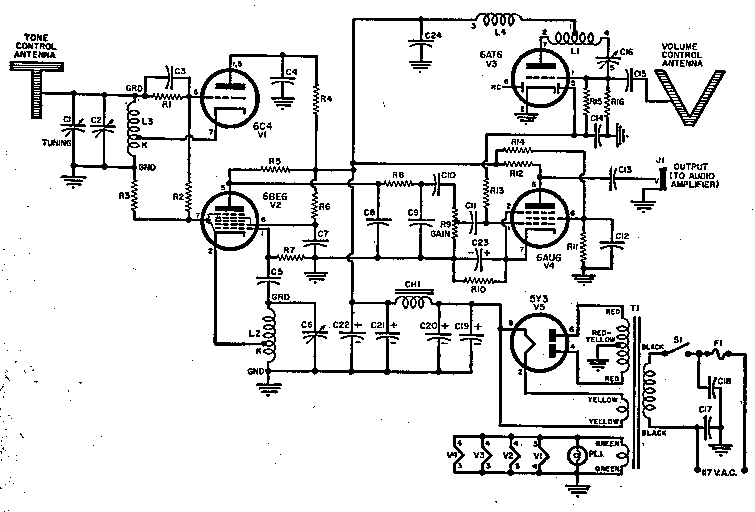
In operation, the signals from a variable frequency RF oscillator (the 6C4 stage) are combined with the signals from a fixed frequency RF oscillator in the mixer stage (6BE6). The difference frequency output, an audio frequency, is fed through a filter circuit to remove any RF signals that might remain and then to a variable gain amplifier (6AU6). The amount of amplification given by the 6AU6 stage depends on its grid bias and this, in turn, depends on the output of a third high frequency oscillator (6AT6).
One antenna permits the operator to vary the frequency of the 6C4 oscillator ("T" or tone control antenna) and hence the pitch of the note produced. Another antenna permits the operator to vary the output of the 6AT6 oscillator ("V" or volume control antenna) and hence the loudness of the note. By moving his hands closer to and away from the two antennas, the musician changes capacities to ground in the two oscillators, and can play any note desired.
Many other Theremin designs were published in the 1950s and 1960s. My article about
the January, 1961 Electronics Illustrated has complete plans for
a five-tube Theremin similar to this one (no custom coil winding required).
The August, 1962 issue of Popular Electronics shows how to convert an inexpensive
five-tube radio into a Theremin. The January, 1966 issue of Popular Electronics
shows plans for a solid-state version dubbed the Lumemin, which
substitutes photocells for the antennas.
Theremin History and Resources
The greatest Theremin artist
was Clara Rockmore, who trained with Leon Theremin and performed around
the world.
A Theremin is fiendishly hard to play and few people other than Rockmore
ever mastered it sufficiently to play at the concert level. I have tried playing restored RCA Theremins
at a museum in San Francisco and at the Spark Museum of Electrical Invention in Bellingham, Washington,
and I can testify to the difficulty. With nothing to guide or rest your hands
on, it's tricky even to hold a simple, clear note!
Contrary to popular belief, the Beach Boys did not use a Theremin in their
song "Good Vibrations." The device used was an
Electro-Theremin,
an obscure instrument based on an audio oscillator. The musician Sun Ra did use a Theremin
(as well as a Hammond Solovox)
in his album Deep Purple
Theremin music figured prominently in the sound tracks of films, including
The Day the Earth Stood Still,
starring Michael Rennie, and
Spellbound,
starring Ingrid Bergman and Gregory Peck and featuring a score by Miklos Rosza.
Interest in the Theremin has grown in recent years. The 1990s documentary film,
Theremin: An Electronic Odyssey, told the story of Leon Theremin.
You can also buy CD collections of Theremin music.
The Art of the Theremin, released by Delos,
contains twelve performances by Clara Rockmore herself. You can even buy the complete soundtrack
of The Day the Earth Stood Still. All of these items
are available from amazon.com
and other retailers.
Modern Theremin kits are also available, notably from PAIA Electronics.
You will find many websites devoted to Theremins. One of the best
is Theremin World.
A 1961 Theremin Design, 2013 Style
Elsewhere in our
Literature section, you'll find the January, 1961 issue of
Electronics Illustrated magazine, which contains plans for building another
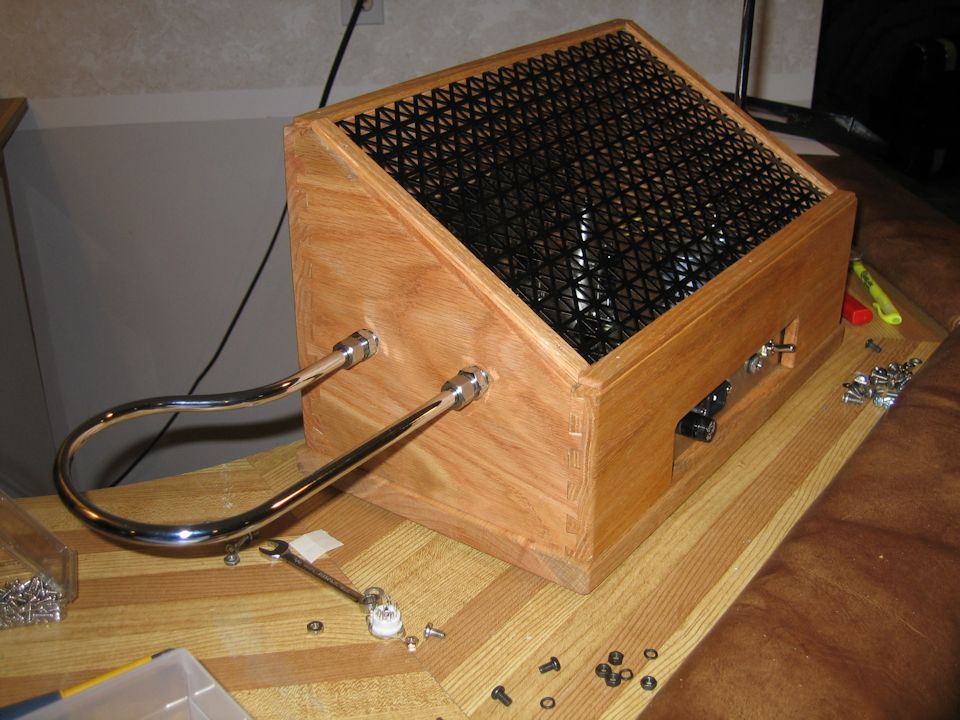
tube Theremin. In 2013, I was contacted by Craig Hanson, who had
built a Theremin following that design. The photo shows Craig's Theremin in
a custom cabinet:

In his
article in our
Building section, Craig explains how he successfully completed this project.
Congratulations, Craig! If anyone else builds a Theremin using either the 1955 or 1961 plans,
kindly contact me via email.
|