Zenith Model 7G605 "Clipper" TransOceanic Radio (1942)


Here you see the legendary "Clipper," the original TransOceanic
portable that launched a radio dynasty lasting 40 years.
The Zenith TransOceanic was the brainchild of Commander Eugene F.
McDonald, the head of Zenith and a dedicated traveler and yachtsman.
Frustrated that ordinary Zenith sets didn't perform well in
remote areas, he ordered his engineers to develop a new
portable that could receive shortwave broadcasts anywhere in the world.
After some two years of development, with McDonald himself testing the
prototypes, Zenith produced a rugged, utilitarian set that could receive five
shortwave bands (49, 31, 25, 19, and 16 meters) in addition to regular
AM broadcasts. The quality standards were high, as was the price—$75,
which represents almost $700 in today's dollars.
War Baby
Model 7G605's history is intimately connected with World
War II. It began manufacturing around October, 1941 and went on
sale to the public in January, 1942.
That was just in time to supply
a few lucky World War II soldiers with a rugged portable that they and their
buddies could use anywhere in the world. TransOceanic ads from these years feature
testimonials from grateful owners, describing how their faithful sets survived
dunking, falling from jeeps, extreme climactic conditions and other misadventures
in faraway lands, all the the while providing welcome news and
entertainment from home.
The last Clipper was built in April, 1942, when the US government shut down
all domestic radio manufacturing to provide for military needs. My Clipper bears
serial number T852064, indicating it was made in the first
production run of 10,000 units.
Zenith took advantage of the wartime experience to cloak
the TransOceanic with an aura of glamor that remains to this day.
The legend is firmly grounded in reality, however. For its time,
the original TransOceanic was indeed a high-performance set, built to high
standards. And Zenith maintained those standards for the TransOceanic line
over a period of decades.
Description
Like its cheaper "companion" set, the
6G601M Universal, the
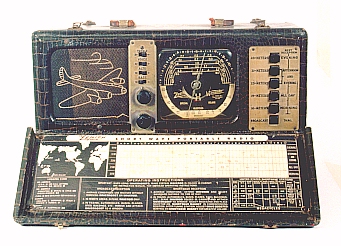
Clipper has a cabinet that's basically a little suitcase, with detachable
front cover and hinged back. (The front cover looks a little off-kilter here,
but that's because I wasn't quite on-center when I took the photo.)
Most Clippers feature the bomber grille pattern
shown here. A few sets in the first production run used the same sailboat
design as the 6G601M, but the sailboat was soon replaced by the bomber
by order of the patriotic Commander McDonald.
For a 1940s appliance, this set is quite user-friendly, with simple controls and
integrated instructional material.
To the far right are the six bandswitches, each marked to indicate the best time
of day for reception on its band. Further operating instructions appear
on a card permanently mounted inside the front cover.
The round power/volume and tuning knobs feature a distinctive "lightning Z"
Zenith logo. Above them is the Radiorgan, a group of four tone
switches marked Treble, Voice, Alto, and Bass.
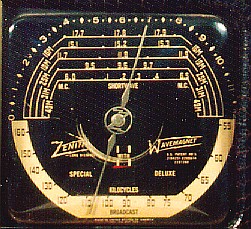
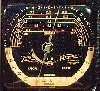
The dramatic gold and black tuning dial features a delicate pointer that
repeats the lightning Z emblem.
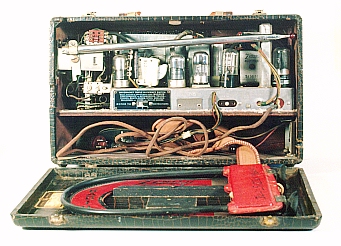
Zenith made much of the TransOceanic's distinctive antennas. The large
telescopic antenna was dubbed the Waverod. It can be rotated upright, then extended vertically.
The second antenna is called the WaveMagnet, a moniker that Zenith applied to many antennas over the years.
It is a big loop antenna at the end of a flexible straplike cable
that you can plug into the back of the radio. The body of the
antenna has rubber suction cups.
When not in use, it stows away with clips inside the back cover.
Both antennas can be seen in the next photo.
With its cable and suction cups, the WaveMagnet
could be attached to the window of a train, airplane, or
boat. Ordinary radios might be silenced inside those
metal vehicles, but you could improve your reception by
sticking your WaveMagnet onto the window next to you.
The rubber suction cups on WaveMagnet antennas always become dried and stiff with
age. I have been told that you can revive their pliability by soaking the
suction cups in a solution of WD-40 for several days—a procedure that
I haven't yet tried.
This radio employs "loktal" type tubes
which snap securely into their sockets. The six tubes are: 117ZG6, 3Q5, 1LN5,
1LA6, 1LN5, 1LD5. The Clipper can use either line current (110-volt AC or DC)
or DC power from a large battery pack.
My set has its original cloth-covered
power cord. Headphones were available as an option. They plugged into
a two-pronged jack in the back of the chassis.
Apart from a broken leather handle and some minor case dings, all my Clipper really
needs is some cleaning and a routine electronic restoration. You can buy
a few different styles of new leather handle from
Antique Electronic Supply, although none is an
exact match for this one.
Before starting any electronic restoration, you should
get a schematic to guide your work and help you understand the electronics.
You can download the 7G605 service manual from
Nostalgia Air
or order it from one of the sources listed in our Parts page.
The TransOceanic Legacy
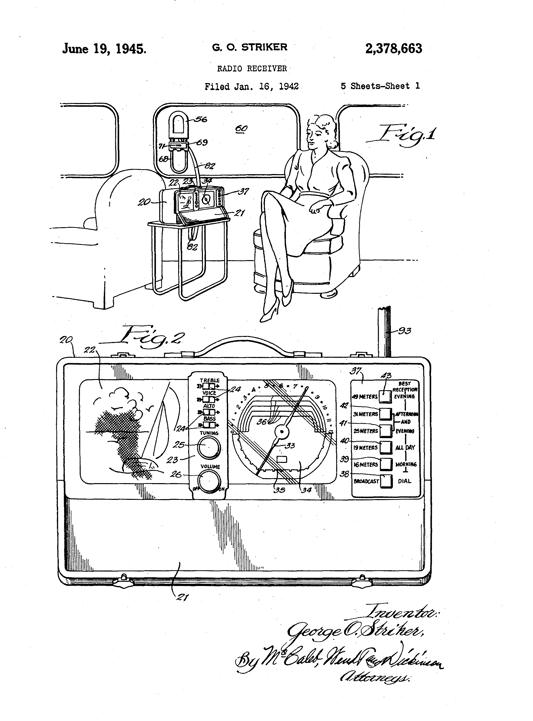
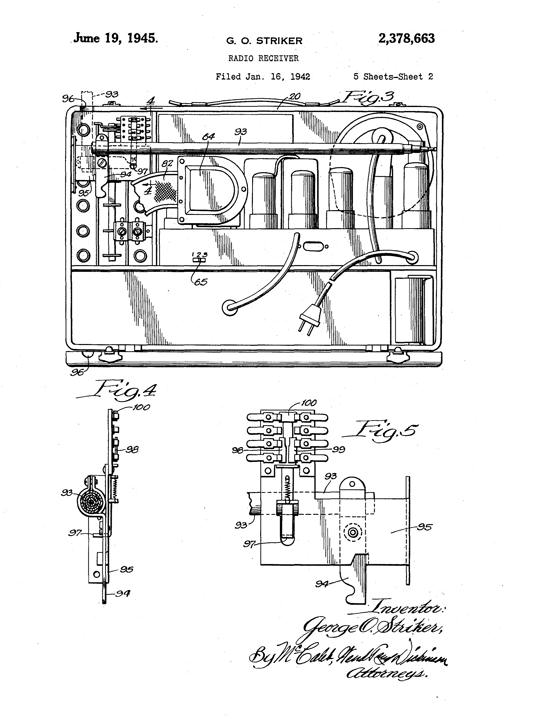
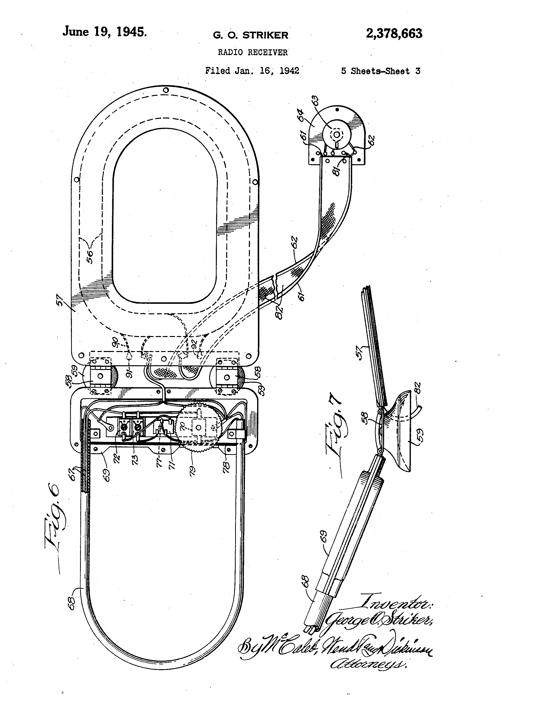
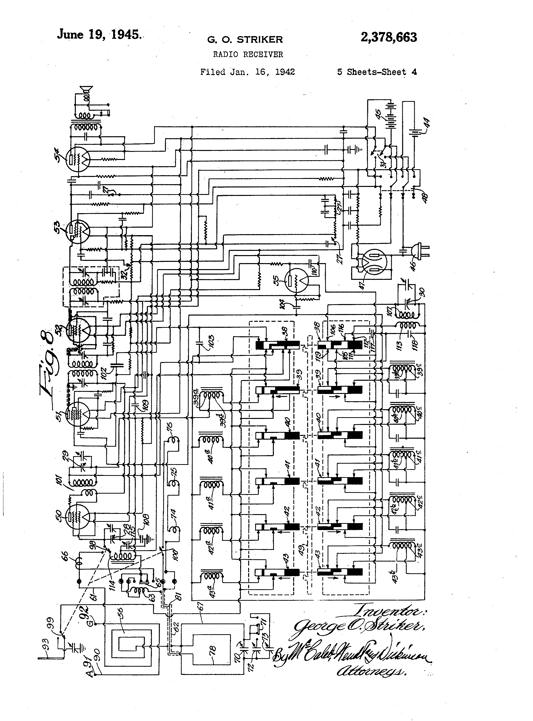
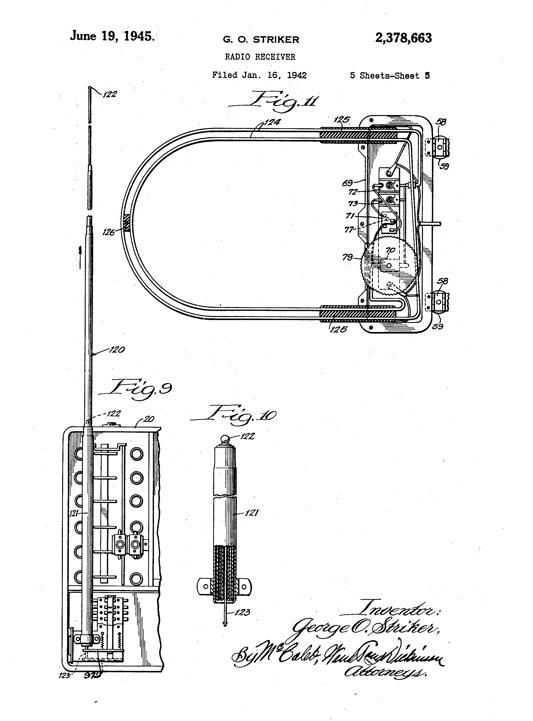
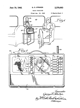
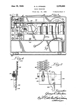
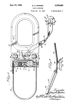
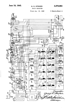
While researching other Zenith patents, I ran across No.
2,378,663,
a remarkable document that includes many details of the TransOceanic Clipper.
This patent drew upon others held by Commander McDonald himself.
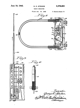
Numbers 2,237,260
and 2,250,387
present the general idea of a portable radio with detachable antenna that can be
stuck onto a window.
In this document, however, you see the entire radio, from outward appearance to
construction details and even the schematic diagram. As you can see from the
diagrams, this is unmistakeably the Clipper, not some generic box representing
any portable radio.
The full patent
runs to 17 pages and makes interesting reading if
you don't mind wading through dense legalese. Although Zenith made various
improvements over the next four decades, this patent created
the framework for all subsequent TransOceanics—surely one of the
longest-lasting designs in radio history.
The other articles in this section chronicle how the TransOceanic evolved
from this early form to its final incarnation, the all-transistor R-7000.
As an historical footnote, despite this highly detailed patent, several
other companies, including RCA, Hallicrafters, and Stromberg-Carlson,
produced portable multi-band radios that were clearly knockoffs of the TransOceanic.
I don't know whether Zenith ever troubled to sue them
for patent infringement. Since none of the "TO clones" sold
well, perhaps Zenith decided it wasn't worth the bother.
|