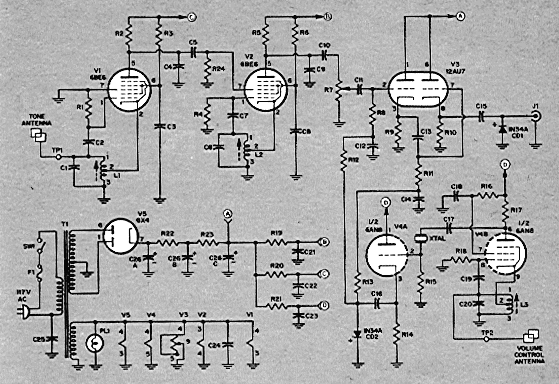
The circuit produces an audio tone by combining the outputs of two RF Hartley oscillators V1 and V2. Pentodes are used because they yield a larger output than triodes and they are more stable under a varying load. V2 also serves as a mixer for the outputs of the two oscillators to obtain the difference frequency which is the audio tone. When a hand is brought near the tone antenna, V1's oscillation frequency changes because the hand adds capacity across tank coil L1.
The audio tone appears at the plate of mixer V2 and is coupled to the grid (pin 2) of V3 through volume control R7. Any RF in the signal is bypassed to ground by capacitor C9 and by the input capacitance of V3. V3 is wired as two cathode followers, the output of one feeding the other, with the grid bias (and hence gain) of both controlled by V4A
The output of V3's second cathode follower is applied to output phono jack J1. Diode CD1 is connected across J1 to "distort" the waveform for a more musical sound.
The pentode portion of V4B (6AN8) is a Hartley oscillator operating close to 500 kc. The output of V4B is coupled to the crystal, which is in series with R15. At its resonant frequency, the crystal has minimum impedance and therefore the maximum signal voltage appears across R15. This is applied to the grid of V4A.
The cathode follower output of V4A is rectified by diode CD2 to produce a negative bias voltage which serves to cut off V3. When V4's frequency of oscillation is varied by hand capacitance near the volume antenna the oscillator frequency shifts from the resonant frequency of the crystal. Since the crystal will not pass this new frequency, there's less signal applied to the grid of V4A and the lower negative bias developed permits the audio signal to get through V3.
The power supply circuits are conventional. A full-wave rectifier (V5) is employed with additional filtering to prevent the oscillators from interacting through the power supply.
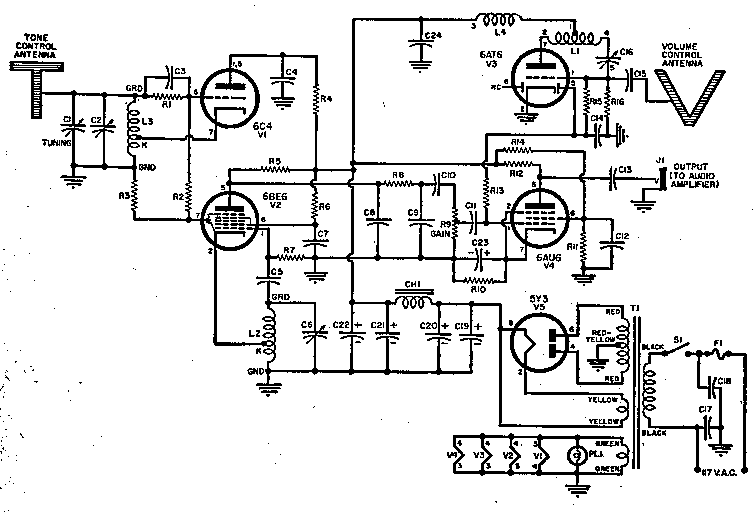
In operation, the signals from a variable frequency RF oscillator (the 6C4 stage) are combined with the signals from a fixed frequency RF oscillator in the mixer stage (6BE6). The difference frequency output, an audio frequency, is fed through a filter circuit to remove any RF signals that might remain and then to a variable gain amplifier (6AU6). The amount of amplification given by the 6AU6 stage depends on its grid bias and this, in turn, depends on the output of a third high frequency oscillator (6AT6).
One antenna permits the operator to vary the frequency of the 6C4 oscillator ("T" or tone control antenna) and hence the pitch of the note produced. Another antenna permits the operator to vary the output of the 6AT6 oscillator ("V" or volume control antenna) and hence the loudness of the note. By moving his hands closer to and away from the two antennas, the musician changes capacities to ground in the two oscillators, and can play any note desired.