Zenith Model T1816R Television (1955)


People either love or hate the design of this classic 1950s black and white television.
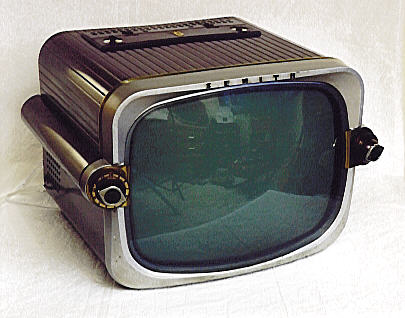
I belong to the "love it" camp. With rounded, futuristic lines and cat's-eye shaped knobs
on either side of the screen, it reminds me of a robot or space alien.
Made in 1955, this large metal-cased TV was designed to sit on a table or
a stand. The cabinet is dark maroon with a contrasting silver bezel and
gold accents in the knobs. The Zenith name appears in raised letters at the top
of the bezel and there is a small gold metal Zenith logo on the control panel at
the top.
It has a seventeen-inch screen and it seems to weigh about seventeen tons!
I purchased this set for $35 in January, 1998.
Maiden Flight
As found, the TV was in excellent cosmetic
condition but the electronics obviously needed work.
As with all vintage electronics, this one was not immediately switched on at full power.
Instead, I gradually increased the operating voltage with my
variac, watching for any signs of trouble.
Although the screen lit up on the first try, the picture was
unwatchable: either a featureless expanse of snow or a maelstrom of
zigzagging lines. The speaker emitted nothing but static. After a moment,
I discovered that you could tune stations better by rocking and carefully holding
the tuning knob slightly off center—a sign of dirty contacts in the tuner switch.
I carefully sprayed a small amount of DeOxit electronic cleaner onto
the tuner contacts and worked the tuner vigorously through its entire range. This treatment
often removes corrosion and built-up dirt on the contacts,
allowing the tuner to operate normally.
Conveniently, the tuner is located near the back of the chassis, where you
can reach it by simply removing the cabinet back. A long extension connects
the tuner to the knobs in front.
When I powered up the TV again, I was pleased to
see that the tuner cleaning had worked. The picture was still a mess of zigazgs, but
I could tell that the tuner was zeroing in on each channel, and now some audio came through.
After some adjustment of the vertical and horizontal hold controls, a
wobbly picture appeared. It was far too short and there was lots of "foldover" at the
top, but a picture is a picture!
The top panel near the rear of the cabinet exposes two additional
adjustments—vertical height and linearity. Using a screwdriver,
I slowly adjusted these controls to bring the picture to the correct height and
eliminate the foldover. The next photo shows the results.
Although watchable, the picture still wasn't ideal. It was too large in both the
horizontal and the vertical dimensions, as I could tell by comparing the picture on a
modern solid-state set in the same room. The sound was also very buzzy at the point
where the picture looked best. To improve the sound, you had to adjust the fine tuning
somewhat "off center" of the station, degrading the video quality.
For a maiden flight, however, this was extremely encouraging. The major systems
were all basically operational. With luck, I might only have to finish cleaning
the controls, replace the paper capacitors, and possibly touch up the alignment.
Electronic Restoration
In the days since buying the TV, I had gotten an original of its
Sams Photofact folder, which includes complete schematics and
technical data. You can buy this manual (Set 292, Folder 12) directly
from Sams.
Following instructions in the manual, I carefully
removed this heavy chassis from the cabinet. In case you're wondering,
this is done by placing the TV face-down on a soft surface. I used
a heavy bath towel laid on the couch to cushion the glass picture tube.
After loosening the mounting screws, you then draw the cabinet upward and away
from the chassis. The entire faceplate, including knobs, remains in place.
Before making any replacements, I cleaned the entire chassis
and cabinet inside and out. Next, I tested all of the tubes.
Only two of them, the 5BK7 RF amplifier and the 6AU8 vertical multiplier, were weak
enough to require replacement.
On the whole, this looked like a pretty high-quality television.
Of the radio's 74 capacitors, only 14 were the unreliable paper type.
The rest were either electrolytics or reliable ceramic units.
Like many tube electronics of the early 1950s, this set used selenium rectifiers
in the power supply, in place of a rectifier tube. I replaced the
unreliable selenium units with modern silicon diodes. The originals
were disconnected but left in place for aesthetic reasons.
"Recapping" (replacing old capacitors) took a couple of evenings and
involved no special difficulties. Compared to my cramped
1957 RCA 14-S-7070G television, this one
has a fairly roomy chassis.
The following photo shows the chassis after installing fresh capacitors.
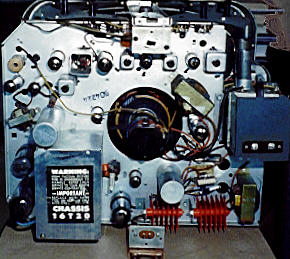
The next photo shows the chassis from the rear. Notice the pair of
selenium rectifiers. They are the dark orange finned rectangular objects
near the right bottom.
I always replace selenium rectifiers in old equipment. They
are not reliable and when they fail, they can give off an awful odor.
The selenium unit can be replaced with a modern
silicon diode (type 1N4007) that costs about $1.00. After the above photo was taken,
I mounted the new diodes right above the old selenium units, leaving
the original rectifers in place (but disconnected) for appearance's sake.
Then I installed the new tubes and tweaked the vertical height and
linearity. The picture looked great, with good sharpness and contrast.
The picture was slightly off kilter, however. I
remedied this condition by carefully manipulating adjustment collars on
the neck of the picture tube.
I also adjusted the Zenith's "buzz control" to minimize buzzing in
the audio when you view very high-contrast scenes, such as white letters
on a black background. My barberpole
Philco Predicta also has a buzz control, located
on the chassis.
2014 Update
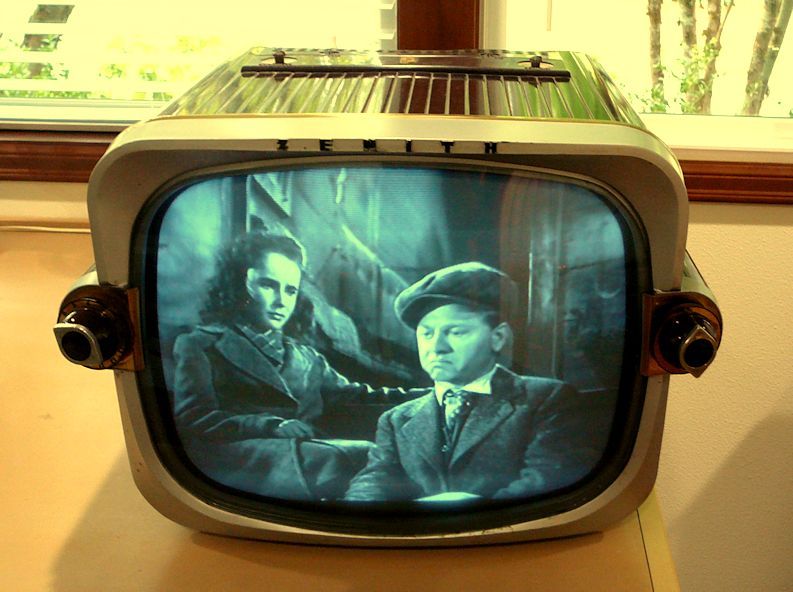
In 2014, after remodeling my workshop, I played this TV for the first time in ages, and
was pleased to see how well it performs. The picture is bright, with excellent contrast, even
in a brightly lit room:

The second photo shows the Zenith playing near my restored
Philco Miss America TV, which has a new picture tube.
The pictures are quite comparable, even with bright daylight coming in the windows.
This was one of my early TV projects, completed seventeen (!) years ago. In hindsight, there are
a couple of things I would have done differently.
Nowadays, I'm much more cautious about powering up
a completely unrestored set, because old electrolytic capacitors are so unreliable. In some cases,
I replace the electrolytics before I even attempt the first power-up. This TV happened to work, after
a fashion, with no restoration at all (unless you count a quick cleaning of the tuner), but that's not
common, based on the TV restorations I have done since then.
Back in 1998, I used "orange drop" type capacitors to replace the old paper ones. Although orange
drops are excellent from an electronic point of view, they're rather large compared to newer
types, and some people find the orange color garish. Nowadays, I would use smaller brown
"Chiclet" style caps. Those blend better with the original components and they
are easier to fit into tight quarters.
Today I would probably open up the tuner and hand-apply DeOxit cleaner to the contacts with a Q-tip,
rather than spray it on. Hand application avoids getting cleaner onto things (such as phenolic wafers) where
it doesn't belong, and it allows you to carefully clean up any residue with alcohol.
Lastly, instead of merely adjusting the TV's onboard buzz control, I would probably do an
alignment of the audio section. Although the sound is acceptable, I might be able to improve
it even further with those tweaks, and audio alignment is a pretty straightforward process,
as I learned in later restorations.
Final Thoughts
If you're looking for a mid-1950s TV to watch, a Zenith of this type is a good choice.
The screen is large enough for enjoyable viewing and a tabletop requires less
room than a console. This model is a good overall performer, too.
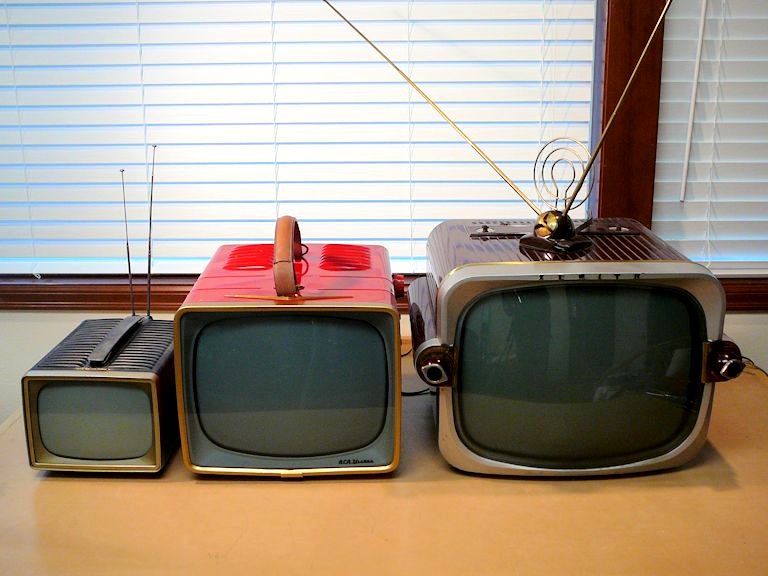
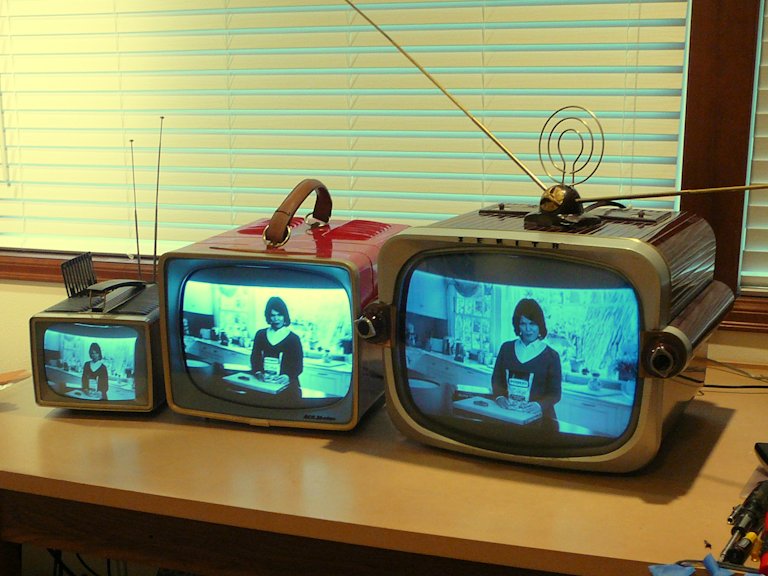
In 2016, I restored an RCA 14-S-7070G and used that occasion to stage a little
TV party showing three of my 1950s metal-case portables. From left to right, they
are an 8-inch RCA 8-PT-7012, the 14-inch RCA 14-S-7070G,
and this 17-inch Zenith.


Only 3 inches larger in diagonal measure, the Zenith's picture tube offers
significantly more viewable area than that of the 14-inch RCA, and it positively
dwarfs the 8-inch set.
|